Travel guide · Golden Whip Stream
Golden Whip Stream: the easiest world-class walk in Zhangjiajie
Every other headline sight in Zhangjiajie looks down on the pillars. Golden Whip Stream walks you along their feet: about 7.5 km of nearly flat, shaded path beside clear water, with 300-metre towers overhead and wild macaques in the trees. It asks almost nothing of your legs and gives back the park’s most intimate scenery.
Short answer
Golden Whip Stream is a roughly 7.5 km, mostly flat valley walk through the heart of Zhangjiajie National Forest Park, from near the Forest Park main gate to Shuiraosimen, taking 2.5–3.5 unhurried hours. It is covered by the park entrance ticket (about ¥225–230, park-set) with no cableways required, wild macaques live along it, and it is the park’s best option in rain, heat, or for kids and seniors. At Shuiraosimen, buses connect to the Bailong Elevator for Yuanjiajie.
Key facts
- Length
- About 7.5 km end to end, almost entirely flat
- Time
- 2.5–3.5 hours at sightseeing pace
- Route
- Forest Park main gate area to Shuiraosimen (Water Winding Four Gates)
- Cost
- No extra charge — covered by the park entrance ticket (about ¥225–230)
- Wildlife
- Wild macaques along the whole valley — do not feed them
- Namesake
- Golden Whip Rock, a ~380 m pillar glowing gold in low sun
- Best conditions
- Morning light; also the park’s best walk in rain or summer heat
- Connects to
- Bailong Elevator and Yuanjiajie via buses at Shuiraosimen
A valley-floor walk beneath the towers
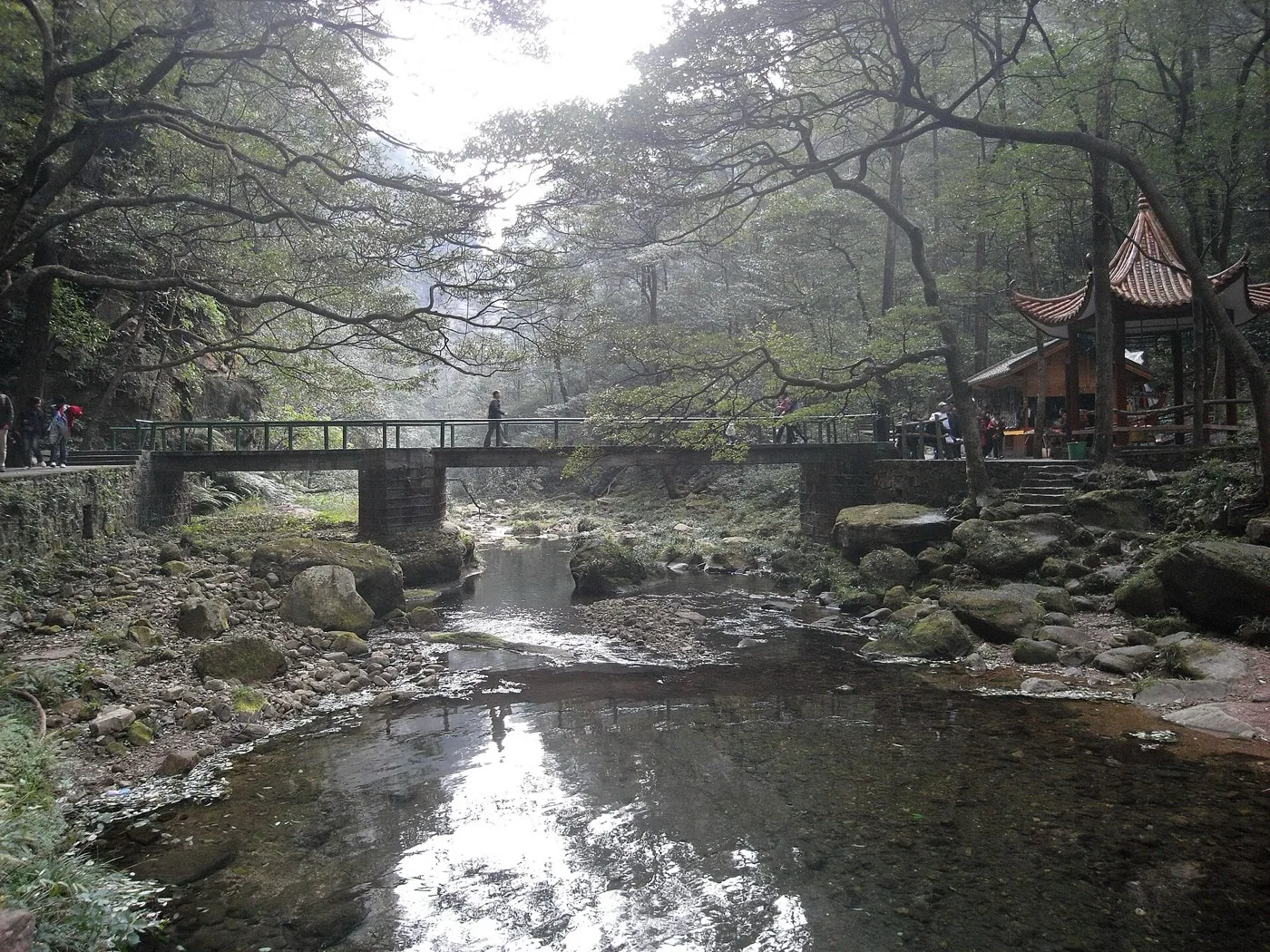
The stream cuts a green corridor straight through the pillar field, and the trail follows the water the entire way — paved, shaded, and so nearly flat that the total elevation change over 7.5 km is barely noticeable. Overhead, sandstone towers rise 200–300 metres on both sides, close enough that you crane your neck rather than reach for a zoom lens. This is the same landscape you saw from the Yuanjiajie rim, experienced from the bottom of the canyon instead of the top — and the change of perspective is the whole point.
It is also, quietly, the best-engineered crowd escape in the park. Tour groups typically walk only the first kilometre or two from the main gate before turning back for the buses; past the halfway point the trail thins to a fraction of gate-area density, and the last stretch before Shuiraosimen can feel close to private on a weekday.
The route, end to end
Walking from the Forest Park main gate side, the first landmark is the namesake: Golden Whip Rock, a sheer pillar of roughly 380 metres that takes on a metallic gold sheen in low-angle light — the “whip” of an emperor’s legend, standing guard over the confluence. The trail then settles into its rhythm: bends of the stream, named rocks with fanciful titles on bilingual plaques, small bridges crossing and recrossing the water.
The walk ends (or begins, if you go the other way) at Shuiraosimen — “Water Winding Around Four Gates” — where several streams meet and the valley opens out. From here, park buses run to the foot of the Bailong Elevator, which is what makes the stream a connector and not a dead end: valley floor in the morning, plateau rim in the afternoon, no backtracking.
Direction advice: starting from the main gate puts the best light on the pillars in the morning and lands you at the elevator when its queue is typically past its worst. Starting from Shuiraosimen and walking out to the gate works better as an afternoon wind-down.
About the monkeys — please read this one

Wild macaques live along the whole valley, and they are one of the genuine joys of the walk: mothers with clinging infants, juveniles ambushing each other over the stream. They are also professional thieves. These are wild animals habituated to people, and they associate plastic bags and open backpacks with food. Keep food zipped away and out of sight, do not eat while walking through an active troop, hold phones firmly near them, and never, ever feed them — it is prohibited, it makes them bolder, and bold macaques eventually get relocated or worse.
Treated with sense, they are completely compatible with a family walk; incidents almost always involve a visible snack. Photographers: a short zoom and patience beat approaching every time. If a macaque bares its teeth, you are too close — back away without eye contact and give the troop the path.
Combining the stream with the high country
The classic full day: walk the stream in the morning coolness, lunch near Shuiraosimen, then ride the Bailong Elevator (roughly ¥65–72, park-set) up to Yuanjiajie for the afternoon on the rim. You experience the pillars from below and above in a single day, in the right light for each, with the elevator doing all the climbing.
The reverse also works and is underrated in summer: rim viewpoints early, then descend and let the shaded, water-cooled valley absorb the hot afternoon. In rain, the stream is simply the best place in the park — the pillars vanish into cloud up top, while down here waterfalls appear on the cliff faces and the forest turns saturated green.
Kids, seniors and anyone saving their knees
This is the walk we recommend first to multi-generation groups: flat, paved, shaded, with benches, toilets and snack stalls at intervals, and exit points that let you shorten it — you can walk the first section and double back to the gate, or start at Shuiraosimen and do half. The full 7.5 km asks only time, not fitness.
One honest note for a licensed guide’s value here: the stream is impossible to get lost on, but it is easy to mis-plan around — walking it at the wrong time of day, in the wrong direction for your onward route, or straight through the only crowded hours. A private guide folds it into the day so it connects to the elevator, the light and lunch — and has a knack for spotting the macaque troops, the water birds and the giant salamander story you would otherwise walk past.
Frequently asked questions
How hard is the Golden Whip Stream walk really?
Genuinely easy: about 7.5 km of flat, paved, shaded path over 2.5–3.5 hours. If you can walk comfortably in a city park for a morning, you can walk Golden Whip Stream.
Can I walk just part of it?
Yes. Many visitors walk the first kilometre or two from the main gate and turn back; a better half-version is starting at Shuiraosimen and walking half the valley in the quieter direction. There are no mid-route exits, though — commit to a turnaround point.
Are the monkeys dangerous?
Not if you keep food invisible and your distance. Nearly all incidents involve visible snacks or attempts to touch them. Keep bags zipped, do not feed them, and enjoy some of the best free wildlife watching in China.
Does the stream cost extra?
No — it is covered by the forest park entrance ticket (about ¥225–230 for the multi-day pass; prices are set by the park and can change). It is the biggest sight in the park with no add-on fee at all.
Is it worth it in rain?
It is the best thing in the park in rain: the high viewpoints go into cloud, while the valley gains waterfalls and atmosphere. Bring a rain jacket rather than an umbrella-and-camera juggle.
Sources
Planning a Zhangjiajie trip?
Send us your dates and questions on WhatsApp. A licensed local guide answers personally — usually within a few hours (08:00–22:00 China time).