Planning
The best time to visit Zhangjiajie — a month-by-month local answer
Every season works in Zhangjiajie, but they work differently: spring and autumn give the best walking weather, summer gives drama and crowds, winter gives silence and the occasional snow miracle. The dates that matter most are not seasons at all — they are China’s public holidays. Here is the honest calendar.
Short answer
The sweet spots are April–June and September–November: comfortable temperatures, green or golden forests, and manageable crowds. Summer is lush and dramatic but hot, humid and busy; winter is cold and quiet, with occasional snowfalls that turn the pillars into something otherworldly. Whatever you choose, avoid China’s Golden Week (1–7 October), the Labour Day break around 1 May, and Spring Festival (January/February, dates vary) — and do not fear mist, which is when Zhangjiajie looks most like the paintings.
Key facts
- Sweet spots
- April–June and September–November
- Summer (Jul–Aug)
- Lush and dramatic, but hot, humid and crowded with domestic school holidays
- Winter (Dec–Feb)
- Cold and quiet; occasional snow transforms the pillars
- Avoid if possible
- Golden Week (1–7 Oct), Labour Day break (~1 May), Spring Festival (Jan/Feb, dates vary)
- Mist
- Frequent all year — usually a photographic gift, not a problem
- Wettest stretch
- Roughly April–August, often short heavy bursts rather than all-day rain
- Facts checked
- 31 July 2026 — holiday dates shift each year; check the current Chinese calendar
The short version
If you can choose freely, choose mid-April to mid-June or mid-September to mid-November, and dodge the public holidays inside those windows. You get walking temperatures between roughly 15 and 25 °C, forests at their green peak or turning gold, waterfalls fed by spring rain or air polished by autumn clarity, and queues that behave.
If you cannot choose freely — school holidays, visa windows, work — do not cancel Zhangjiajie. Every month here has a working strategy; the mountains do not have an off season, only different moods. The rest of this guide is the honest month-by-month picture, then the holiday calendar that matters more than any of it.
Month by month at a glance
Temperature figures are city-level planning ranges, not forecasts — the summits typically run 5–10 °C colder with wind, and any single week can defy its month. Treat the table as odds, then check a real forecast ten days out.
| Month | Weather (city, rough) | Crowds | Verdict |
|---|---|---|---|
| January | 0–8 °C, damp cold, snow possible | Very low | Silent park; snow lottery; pack warm |
| February | 2–10 °C, cold, wet spells | Low, except Spring Festival | Quiet — but avoid the festival week |
| March | 8–16 °C, warming, showery | Low–medium | Early spring value; some mist-heavy days |
| April | 13–21 °C, fresh, regular rain | Medium | Sweet spot begins — everything turns green |
| May | 18–26 °C, warm, rain bursts | Medium–high early May | Excellent, outside the Labour Day break |
| June | 22–30 °C, humid, thundery | Medium | Lush and waterfall-rich before peak heat |
| July | 25–34 °C, hot, humid | High (school holidays) | Dramatic skies; start days very early |
| August | 25–35 °C, hottest, stormy | High | As July; afternoon storms likelier |
| September | 20–28 °C, easing heat | Medium | Sweet spot returns as school resumes |
| October | 14–22 °C, crisp, drier | Extreme 1–7 Oct, then medium | Superb — but never during Golden Week |
| November | 8–16 °C, cool, clear spells | Low–medium | Autumn colour, sharp light, thin crowds |
| December | 2–10 °C, cold, damp | Very low | Winter quiet; first snow chances |
Spring and early summer: the green surge
From April the park wakes up loudly: fresh leaf on every ledge of the pillars, streams and waterfalls running full on spring rain, and moist air that generates the layered mists Chinese landscape painting is built on. Temperatures are kind to walkers, and the crowds — outside the early-May break — are moderate.
The trade is rain. Spring showers are frequent, mostly short and heavy rather than day-long, and they are exactly what produces the park’s most beautiful hours: the clearing after rain, when cloud tears off the pillars in ribbons. Pack a proper rain shell, accept one soggy interlude per day, and you will be rewarded.
Autumn: the connoisseur’s season
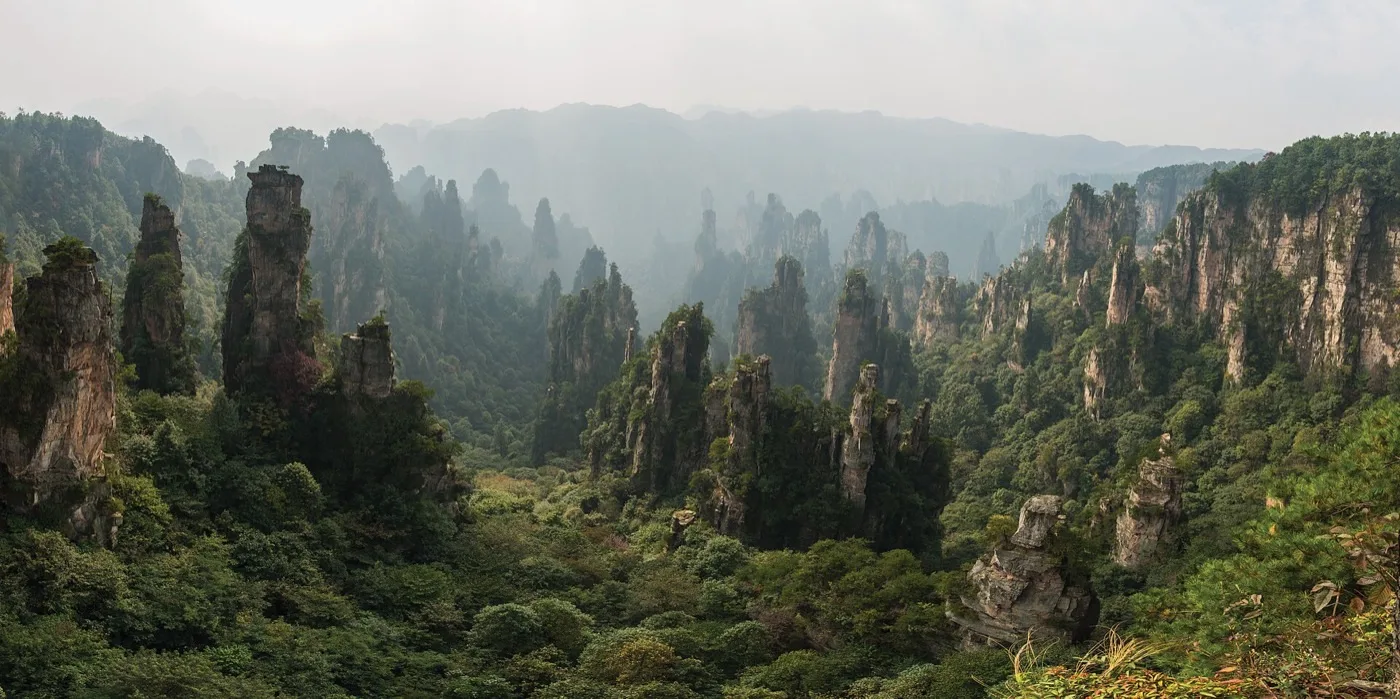
September cools, October crisps, November glows. Autumn brings Zhangjiajie’s most reliable visibility — long clean sightlines from the Tianzi and Yuanjiajie terraces — plus turning foliage that threads red and gold through the evergreen cover on three thousand pillars. Rain eases, humidity drops, and walking weather holds deep into November.
This is our honest favourite, with one enormous asterisk: the first week of October is the single worst time of the entire year to visit (see the holiday section below). Come the week after Golden Week instead, when the country goes back to work and the park exhales — mid-October to mid-November may be the best two weeks on the calendar.
Winter: the quiet gamble that sometimes pays in snow
December to February empties the park. Hotel prices soften, the great platforms are often almost private, and the bare-branch forest reveals rock structure that summer leaf conceals. It is cold — a damp, penetrating cold that demands real layers — and days are short, so plans compress.
Then there is the lottery: several times most winters, snow falls on the high park, and for a day or two Zhangjiajie becomes arguably the most beautiful place in China — white-capped pillars floating in grey silence. It cannot be booked in advance, only pounced on. Travellers already in Hunan with flexible days, and photographers watching forecasts, are the ones who win it. Note that cableways may pause during the storm itself and ice can close individual paths; the reward comes with the clearing.
The holiday calendar that outranks the weather
China’s public holidays move hundreds of millions of people at once, and Zhangjiajie is a top-tier domestic destination. Golden Week, 1–7 October, is the extreme: queues of one to three hours at major rides, full hotels at multiplied prices, and quota sellouts. The Labour Day break around 1 May (several days; exact dates set yearly) is a smaller edition of the same. Spring Festival (Chinese New Year, January or February — dates vary with the lunar calendar) empties cities but fills tourist sites during its middle days.
Smaller three-day holidays — Qingming in early April, Dragon Boat in early summer, Mid-Autumn in September or early October — produce busy weekends rather than chaos. The dates shift every year, so check the current year’s official holiday calendar before fixing your trip; it is the single highest-value five minutes of Zhangjiajie planning.
Mist is a feature, not a bug
First-time visitors fear fog; returning visitors chase it. Zhangjiajie’s pillars were made famous by images of stone towers rising from cloud seas, and those images require mist. A “bad” forecast of rain clearing to cloud is often the best photographic day of a trip, while a flawless blue sky — lovely to walk under — flattens the scenery into a postcard.
The local skill is reading which viewpoints work in which conditions: valley walks and lakes when cloud sits low, high terraces the hour it lifts. This is genuinely hard to do from an app, and it is a core reason travellers hire us: a licensed private guide (¥1,000 per day, per group) rebuilds each day’s sequence around the sky, so mist becomes your trump card instead of your excuse. Tell us your dates on WhatsApp (+7 904 210 4044) and we will tell you honestly what your window is likely to give.
Frequently asked questions
What is the single best month to visit Zhangjiajie?
Pressed for one answer: mid-October to mid-November — post-Golden-Week calm, crisp visibility and autumn colour. May and late September are close seconds.
Is summer a mistake?
No — it is lush, dramatic and full of life, and mornings are workable. Start at gate opening, rest through the hot midday, return for late afternoon, and book air-conditioned rooms. Just expect crowds and heat.
When can I see snow on the pillars?
Occasionally between roughly December and February, a few times most winters, each lasting a day or two. It cannot be predicted at booking range — it rewards flexible travellers already nearby.
Is the park open year-round?
Yes. Individual cableways and paths pause for weather or scheduled maintenance — more likely in winter — but the park itself does not close for a season. Check current notices close to your dates.
How bad is Golden Week really?
The worst queues, prices and quotas of the year, concentrated 1–7 October. If those are your only possible dates, come anyway — but book everything far ahead and consider a guide precisely to out-manoeuvre the crowds.
Sources
Planning a Zhangjiajie trip?
Send us your dates and questions on WhatsApp. A licensed local guide answers personally — usually within a few hours (08:00–22:00 China time).