Travel guide · Tianzi Mountain
Tianzi Mountain: the balcony over Zhangjiajie’s stone forest
If Yuanjiajie is where you meet the pillars face to face, Tianzi Mountain is where you finally see how many there are. Its high viewpoints overlook whole valleys of stone towers at once — the “fields of pillars” that fill every Zhangjiajie panorama you have ever seen. Here is how to visit it well: cableway strategy, the viewpoints that matter, and the sea-of-clouds lottery.
Short answer
Tianzi Mountain is the northern high area of the Wulingyuan landscape, reached by its own cableway (roughly ¥65–80 per ride, park-set) or by long stair paths, and covered by the forest park’s multi-day entrance ticket (about ¥225–230). Its platforms — around He Long Park and the western rim — give the widest views over the pillar fields, at their unearthly best after rain, when cloud seas flood the valleys. Give it half a day, ideally combined with Yuanjiajie into one plateau loop.
Key facts
- What it is
- The high northern viewing area of the Wulingyuan pillar landscape
- The name
- “Son of Heaven” mountain — from the title taken by local Tujia leader Xiang Dakun, per legend
- Cableway
- Roughly ¥65–80 per ride; prices set and adjusted by the park
- Ticket
- Covered by the forest park entrance ticket (about ¥225–230, multi-day)
- Key viewpoints
- He Long Park platforms, the western rim, the Imperial Brush Peaks view
- The special effect
- Sea of clouds over the pillar fields — best odds after rain clears
- Time needed
- Half a day; combines naturally with Yuanjiajie
Why Tianzi is the view you remember
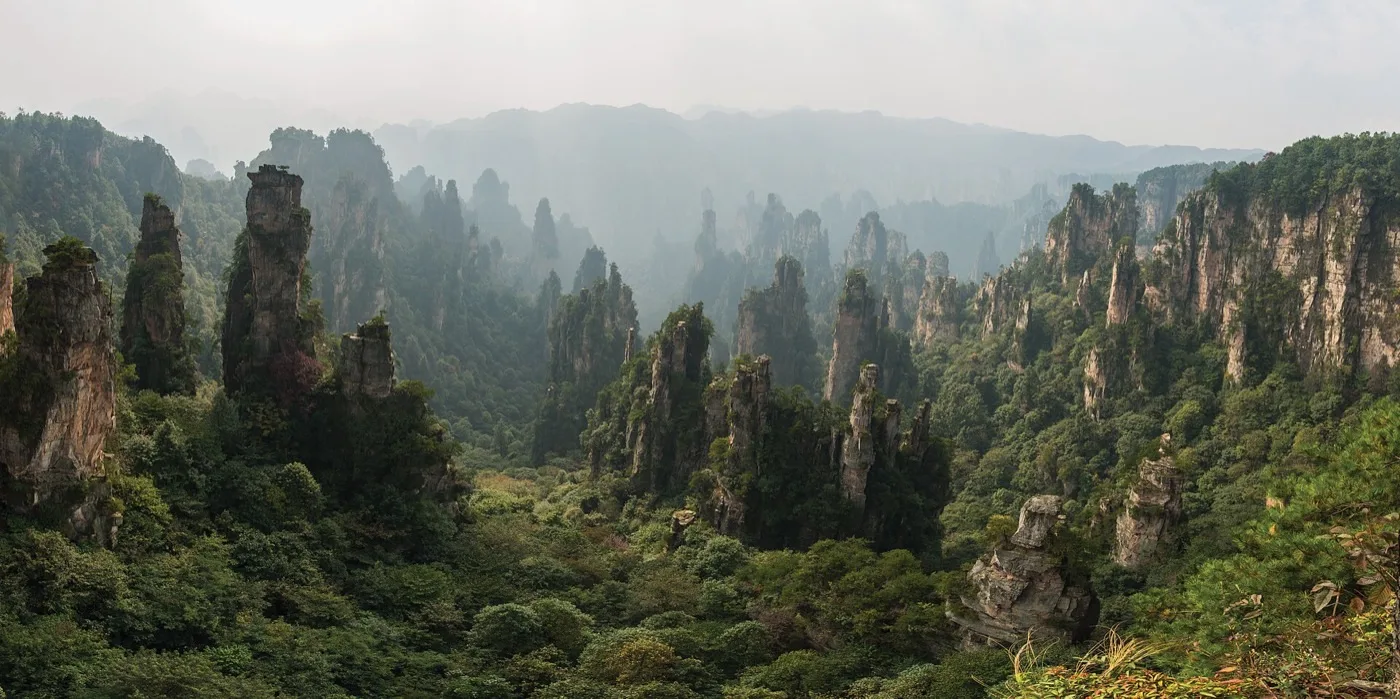
Every visitor photographs Yuanjiajie; almost every visitor’s favourite photograph turns out to be from Tianzi. The reason is scale. Yuanjiajie’s platforms put you among the pillars — thrilling, intimate, but close-range. Tianzi Mountain sits higher and further back, so its rim platforms overlook entire valleys packed with stone towers, hundreds at a time, receding in ranks toward the horizon. This is the “fields of pillars” view: the one that makes people go quiet.
Geologically it is the same story as the rest of the park — quartz-sandstone laid down as ancient seabed, uplifted, then carved by water and frost into more than 3,000 columns — but Tianzi is where the story becomes legible. From up here you can see the plateau the pillars were cut from, the valleys the rivers took, and the whole 380-million-year argument between rock and water laid out like a map.
The Son of Heaven: the legend behind the name
Tianzi means “Son of Heaven” — the title of Chinese emperors. Local tradition ties the name to Xiang Dakun, a Tujia leader who, the story goes, rose in rebellion in the fourteenth century, declared himself Tianzi, and fought imperial troops among these very pillars before his defeat. Several viewpoints carry names from the tale, and local guides tell versions of it that no plaque records.
Treat it as legend rather than documented history — but as legend it does real work: this landscape has been Tujia and Miao country for centuries, and the names on the mountain are a reminder that people lived, farmed and fought here long before the first tourist bus. If your guide is Tujia, as many Zhangjiajie guides are, ask for the family version of the story.
Cableway or stairs — and the bus trick on top
The Tianzi cableway climbs from the northern foot of the mountain to the summit area in a few minutes, for roughly ¥65–80 per ride (the park sets and occasionally changes the fare). The stair alternative is a long, beautiful, quad-punishing climb of a couple of hours that most visitors sensibly skip in the uphill direction. As everywhere in this park, queues at the cableway can reach 1–3 hours on peak days and evaporate at the edges of the day.
The key logistical fact: once on top, free shuttle buses link the Tianzi summit area with Yuanjiajie across the plateau. This is what makes the classic one-day loop possible — Bailong Elevator up to Yuanjiajie in the morning, bus across, Tianzi viewpoints in the afternoon, cableway down. Or the reverse, which often beats the crowd flow. You never need to ascend and descend by the same machine.
The viewpoints that matter
The summit area funnels visitors toward He Long Park, a clifftop park named after Marshal He Long, the Republic-era general born nearby, whose statue stands on the rim. The platforms around it deliver the signature panoramas, including the view toward the Imperial Brush Peaks — a cluster of slender pillars said to resemble writing brushes left standing after an emperor’s use, and one of the most photographed rock groups in China.
Give yourself time to walk beyond the statue plaza. The rim path strings together several platforms in ten to twenty minutes of level walking, and the crowd density drops sharply after the first two. The farther platforms often give a cleaner, quieter version of the same valley — and in mist, each platform sees a different scene as the cloud moves.
- He Long Park platforms — the signature fields-of-pillars panoramas
- Imperial Brush Peaks view — the famous “writing brushes” pillar cluster
- Western rim platforms — afternoon light, thinner crowds
- Fairy Scattering Flowers and neighbouring named rocks along the rim path
Sunrise, mist and the sea of clouds
Tianzi’s party trick is the cloud sea: after rain, when saturated air pools in the valleys overnight, morning can find the entire pillar field submerged under a white ocean with only the tallest towers breaking the surface. It is arguably the single greatest sight in Zhangjiajie — and it is a lottery. The workable strategy is to be in the park on the first clearing morning after a rainy spell, and to get to the rim early, because cloud seas usually burn off by mid-morning.
No luck? Rain and mist still favour Tianzi more than they punish it. Pillars appearing and vanishing in moving cloud is the classic Chinese-painting version of this landscape, and many photographers prefer it to blue sky. Only a full whiteout is a genuine loss — and then the valley walks below are the right call instead.
Doing Tianzi justice in one day
Tianzi rewards the visitor who arrives at the right hour from the right side, walks the rim in the right direction, and has a plan B when the weather moves — which is to say, it rewards local knowledge. A licensed private guide sequences the plateau loop around the day’s actual queues and cloud, knows which platform clears first as mist lifts, and handles the real-name tickets and Chinese-only bus lines invisibly. Independent visitors manage Tianzi every day; guided visitors just tend to be standing in the right place more often.
Frequently asked questions
Is Tianzi Mountain included in the forest park ticket?
Yes — it is part of the same Wulingyuan ticket system as Yuanjiajie and Golden Whip Stream (about ¥225–230 for the multi-day pass, set by the park). The cableway is extra, roughly ¥65–80 per ride.
Can I see Tianzi and Yuanjiajie in one day?
Yes — it is the classic loop: Bailong Elevator up, Yuanjiajie in the morning, shuttle bus across the plateau, Tianzi in the afternoon, cableway down (or the reverse). It is a full day, but a level-walking one.
When is the sea of clouds most likely?
On the first clear morning after rain, especially in spring and autumn — get to the rim early, as it usually dissolves by mid-morning. It is never guaranteed; treat it as a bonus, not a plan.
Is Tianzi suitable for visitors who cannot climb stairs?
Largely yes. With the cableway up and down and the summit buses, the main He Long Park platforms involve modest, mostly level walking. The longer rim paths add stairs but are optional.
Tianzi or Yuanjiajie — if I must choose one?
For sheer scale of view, Tianzi; for the Avatar connection and the natural bridge, Yuanjiajie. But they share one plateau and one ticket — the honest answer is that choosing is a routing failure, not a necessity.
Sources
Planning a Zhangjiajie trip?
Send us your dates and questions on WhatsApp. A licensed local guide answers personally — usually within a few hours (08:00–22:00 China time).